
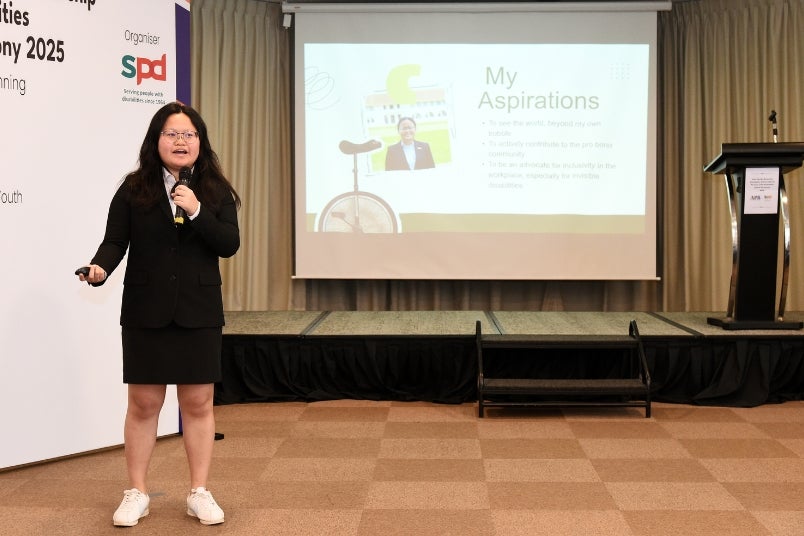
Clara Cher Shining (Y4, Law and NUS College) has used her time at NUS to explore how the law can open doors for communities that often struggle to be heard. Whether assisting non-profits through corporate law clinics or supporting individuals navigating the justice system, she brings a steady belief that legal knowledge should help people move through complex systems with confidence and dignity.
Her commitment to service is shaped by lived experience. As a student with hearing loss, Clara works closely with the Student Accessibility Unit (SAU) under OSA to access tools such as speech-to-text support and live captioning, and she continues to advocate for learning spaces where clarity, patience and understanding allow everyone to participate fully.
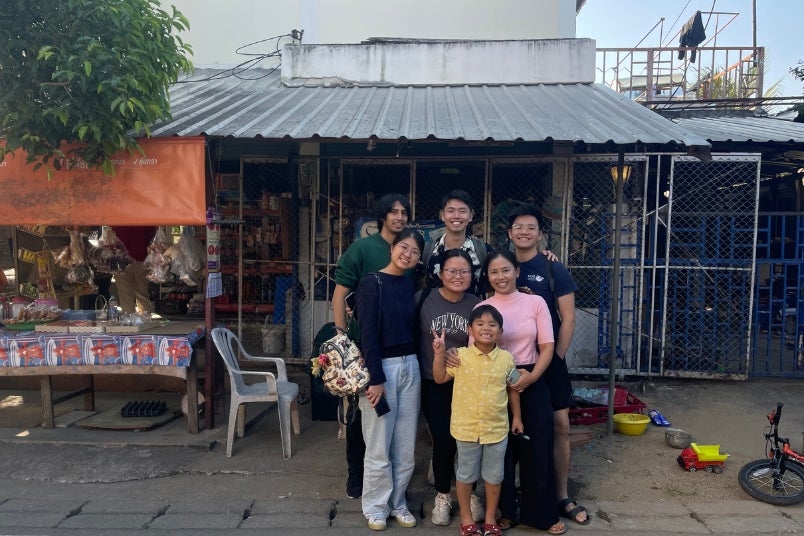
That drive extends beyond the classroom. A community development project in Chiang Mai — where she co-designed a water remediation initiative with a local village — deepened her conviction that meaningful change must be built alongside communities, not for them. This ethos threads through her mentorship work at NUS College, her pro bono involvement at NUS Law, and her daily interactions with peers adjusting to university life.
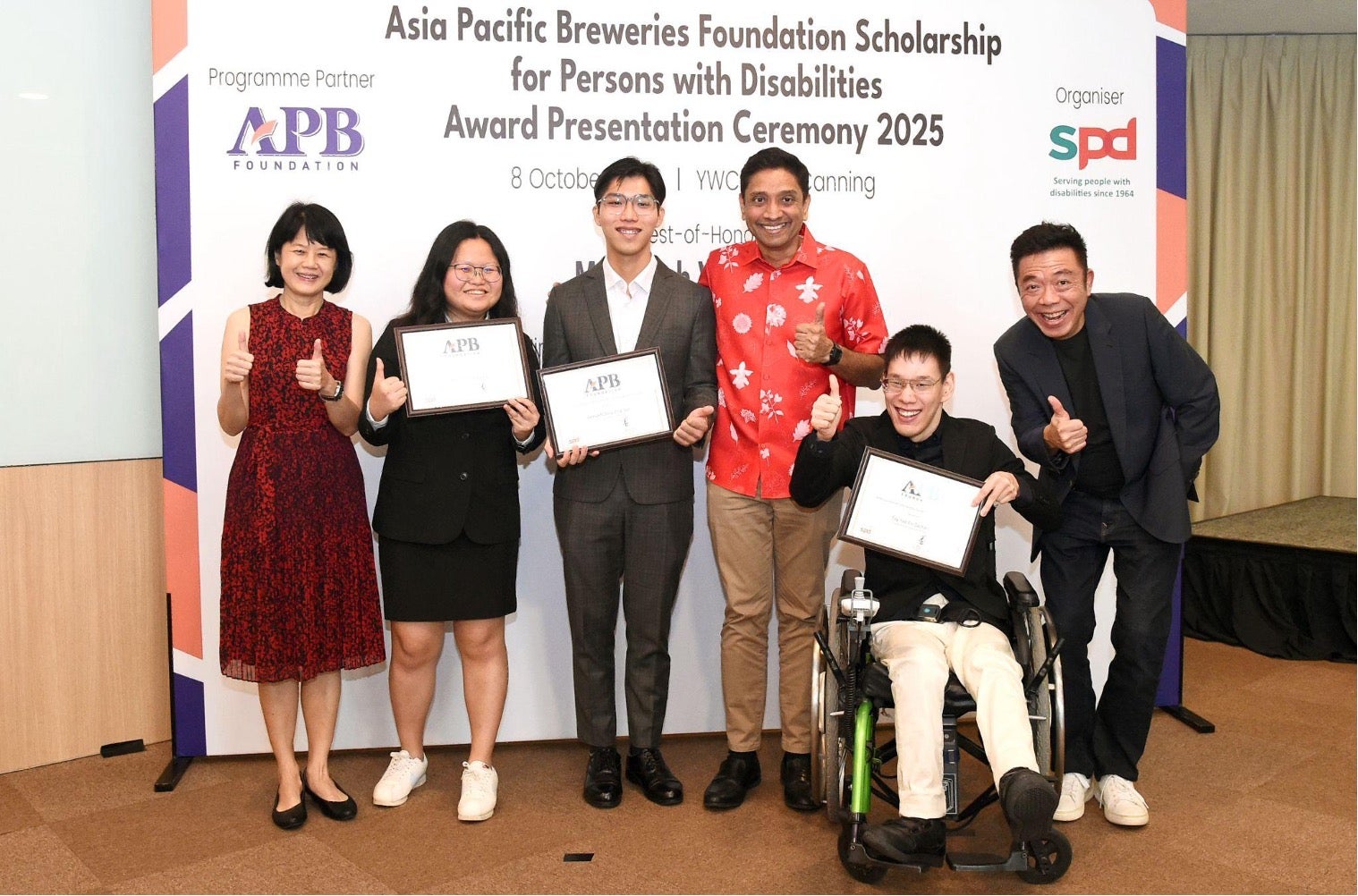
In recognition of her contributions, Clara was recently awarded the bond-free Asia Pacific Breweries (APB) Foundation Scholarship for Persons with Disabilities. OSA spoke to Clara shortly after she was awarded the scholarship.
OSA: Congratulations on being awarded the APB scholarship! Tell us more about it.
Clara: The scholarship is bond-free, and scholars contribute via community service and public education/advocacy. It also serves as a platform to raise public awareness of disability and inclusion. It provides a S$12,000 annual allowance per academic year to offset school-related expenses. With the support, I can focus on my final year, and continue developing my interests and community work with less financial pressures.
OSA: In what ways did OSA’s SAU team support you in your learning at NUS?
Clara: OSA’s SAU team — Zhixiong, Agnes, Annette, and Shernise — have been really supportive during my time at NUS. They helped me procure speech-to-text technology, which has been especially useful in small meetings. They also assisted in communicating my needs to professors, who then made practical accommodations such as enabling live subtitles or captions in classes. The team checks in regularly, points me to relevant funding and support schemes, and connects students to internships with inclusive employers and career workshops. Their support has made it easier for me to participate fully in classroom settings and focus on my learning.
OSA: What are some challenges that you face as a Persons with Disabilities (PWD) studying in NUS? What can we do to make NUS a more inclusive learning community?
Clara: Some challenges are structural, for instance, not all classrooms are designed in ways that can accommodate my learning needs. Acoustics, background noise, and seating layouts can make it difficult to hear clearly, and certain assistive tools like transcription software cannot always be used effectively in those settings. As my disability is invisible, people may not realise I have hearing loss. It can be stressful to keep asking lecturers or classmates to repeat themselves, especially in fast-paced discussions. What helps most is when people are just a little kinder and more patient. Singapore can sometimes be an unforgiving society for people with disabilities, as so much value is placed on efficiency and productivity that it can be easy to overlook those who may need a bit more time or support. I have been very lucky to have friends have supported me, whether by sending me notes, helping me follow discussions, or simply being patient when I need something repeated. These acts of empathy make a big difference and are what make a community truly inclusive.
OSA: Besides pursuing law, you are also actively giving back to the community by doing pro bono work. How did it come about?
Clara: I initially was not sure how the area of law I was most interested in -- corporate law -- could be applied in this space, given that most pro bono work focuses on family or criminal matters. That changed when I took a course at NUS Law called The Corporate Law Clinics. Through this, I assisted non-profit organisations such as Ray of Hope and AWWA Ltd with a range of legal matters, including reviewing contracts and clarifying compliance obligations. It was eye-opening to realise how the legal skills I’ve developed can make a real, practical difference to organisations that serve vulnerable communities. I intend to remain actively involved in pro bono work in my personal capacity, as I believe that lawyers, and individuals, regardless of their area of practice, have the ability and responsibility to use their skills to support those who might otherwise fall through the cracks.
OSA: What are some of these pro bono projects you have participated in?
Clara: At NUS, I have been involved in a wide range of pro bono projects. Under the Criminal Legal Aid Scheme, I assisted a lawyer with the defence preparation for an accused who could not afford representation through conducting research, drafting of representations, and organising files. I have also served as a Project Director with NUS Law Pro Bono Group’s University Court Friends, which is a programme where students volunteer at the State Courts to support litigants-in-person through procedure and forms. Beyond that, I have worked with low-income seniors to complete their Lasting Power of Attorney applications, and also volunteered with the Office of the Public Guardian, where I supported deputies in tracking and filing records for individuals who were no longer able to manage their own affairs.
OSA: What other kinds of advocacy work do you do?
Clara: I strongly believe in peer mentorship and community support. Having personally experienced what it feels like to navigate challenges that are not always visible or easily understood, I have come to appreciate how much difference it makes to have someone who listens and guides without judgment. At NUS College, I have served as a Peer Mentor for three consecutive years, supporting first-year Law-NUSC students as they adjust to university life. I also serve as a Residential Assistant, where I help foster a supportive and inclusive residential community by organising community-bonding events and looking out for residents, offering a listening ear and connecting them with the right campus resources when needed. Through these roles, I have learned that advocacy can start small — by noticing when someone might be struggling, taking the time to reach out, and building an environment where people feel safe to ask for help. Looking ahead, I hope to continue mentoring others, particularly students with invisible disabilities, and contributing to inclusive initiatives that bridge understanding between people of different backgrounds and abilities.
OSA: What words of encouragement or advice would you give to a student with PWD just starting out in NUS, or planning to come to NUS in the next AY?
Clara: Firstly, don’t be afraid to advocate for yourself. You know your needs best, and it is okay to ask for the support or adjustments that will help you thrive. Sometimes it can feel uncomfortable to speak up, but the truth is that most people want to help but they just might not know how unless you tell them. Secondly, never let your disability stop you from trying new things or stepping out of your comfort zone. Whether it’s joining a new activity, taking on a leadership role, or applying for an opportunity, your experiences and perspective add value. You belong here as much as anyone else, and over time, you will find that the more you put yourself out there, the more confident you’ll become in shaping your own path.
Share:
Contributor
Office of Student Affairs