
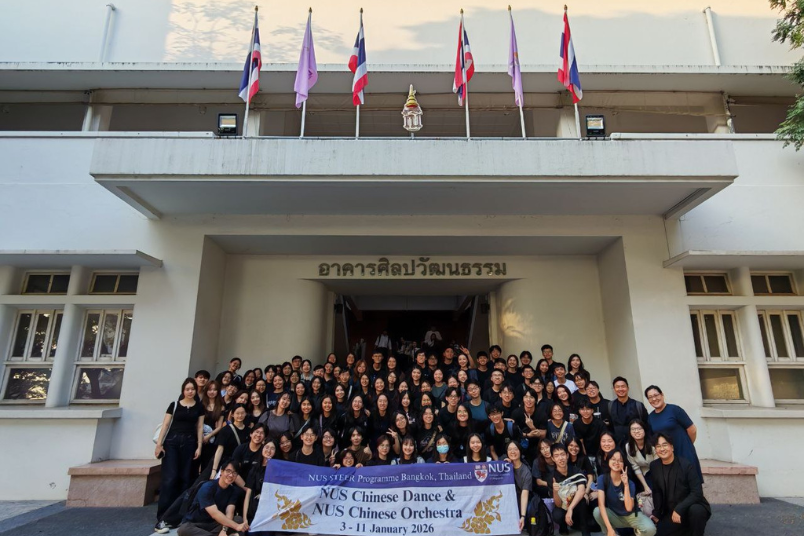
100 students from the NUS Chinese Orchestra (NUSCO) and NUS Chinese Dance (NUSCD) opened the new year with an immersive arts learning trip to Bangkok, Thailand, from 5 to 10 January 2026. Held under NUS Study Trips for Engagement and EnRichment (STEER) programme, the trip offered experiential learning beyond the classroom, deepening students’ understanding of ASEAN arts and culture, with a focus on Thai traditional music, dance and contemporary creative practice.
An academic and artistic exchange
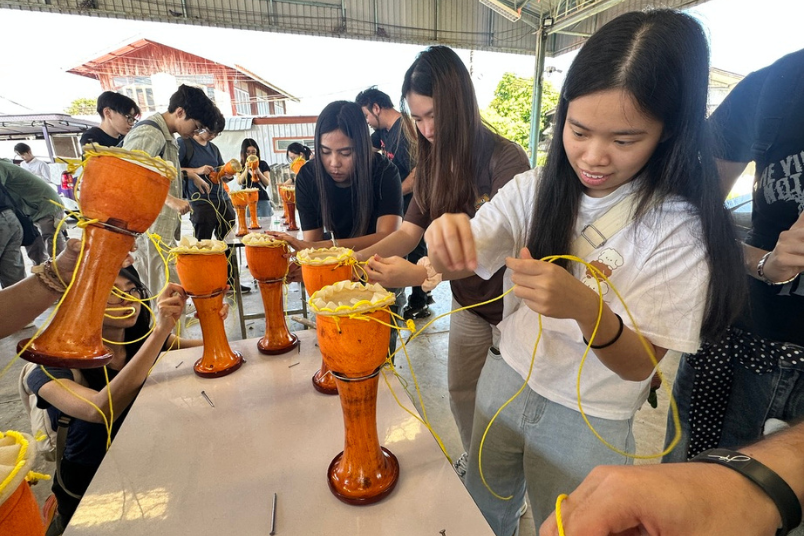
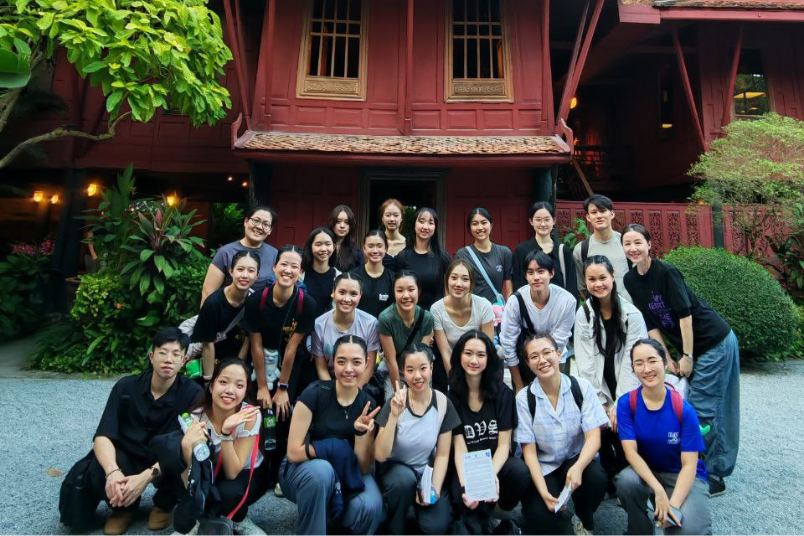
NUS students visited key cultural landmarks such as Ayutthaya (a UNESCO World Heritage Site), Ekkarat DrumMaking Village, The Bangkok National Museum, Bangkok Art & Culture Centre, Jim Thompson House Museum and the Pichet Klunchun Dance Company. At each stop, they explored how heritage is preserved, adapted and reinterpreted.
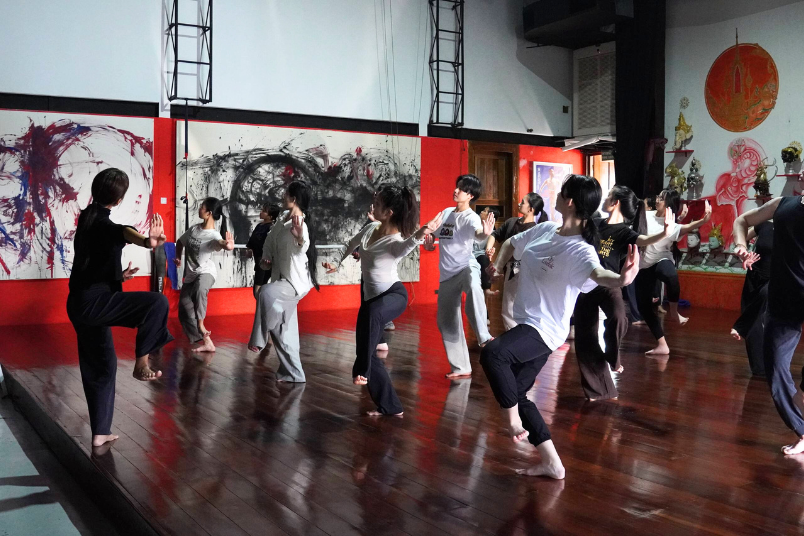
Building on these visits, students moved onto an exchange with dance students from the Bunditpatanasilpa Institute of Fine Arts. NUSCD students learnt traditional Thai dances from various regions and Thai court dance from their counterparts, and taught them some basics of Chinese dance in return.
Afterwards, they participated in a masterclass with choreographer Jitti Chompee, who offered perspectives on multidisciplinary collaboration, and how to bridge traditional arts with contemporary practice. These experiences provided meaningful inspiration for students of NUSCO and NUSCD, whose works seek to blend heritage with new artistic influences.
“We met many artists who actively reinterpret traditional artistic elements by transforming them into contemporary cultural products. I believe it is possible to combine social realism with traditional Chinese dance, so our performances resonate better with audiences,” said Beatrix Chen Yen-Chun (Y2, FOS) from NUSCD.
Learning from partner universities
At Chulalongkorn University (CU), the delegation was welcomed by the University President Prof. Dr. Wilert Puriwat at a hosted lunch, underscoring the strong institutional relationship between our universities.
In his opening address, Prof. Dr. Puriwat emphasised the importance of cultural dialogue and artistic collaboration as integral components of CU’s global engagement strategy, highlighting the role of the arts in fostering mutual understanding within contemporary educational contexts.
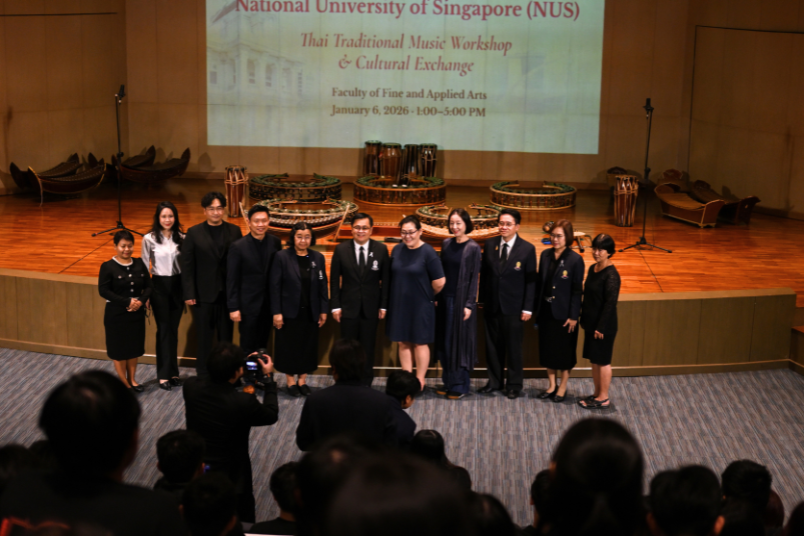
It was followed by a Thai music workshop and a sharing session, Thai Traditional Music: Preservation and Evolution, led by A/P Pornprapit Phoasavadi and Dr Dusadee Swangviboonpong from CU’s Faculty of Fine and Applied Arts. They discussed how traditional music is being sustained amid shifting social and artistic landscapes.
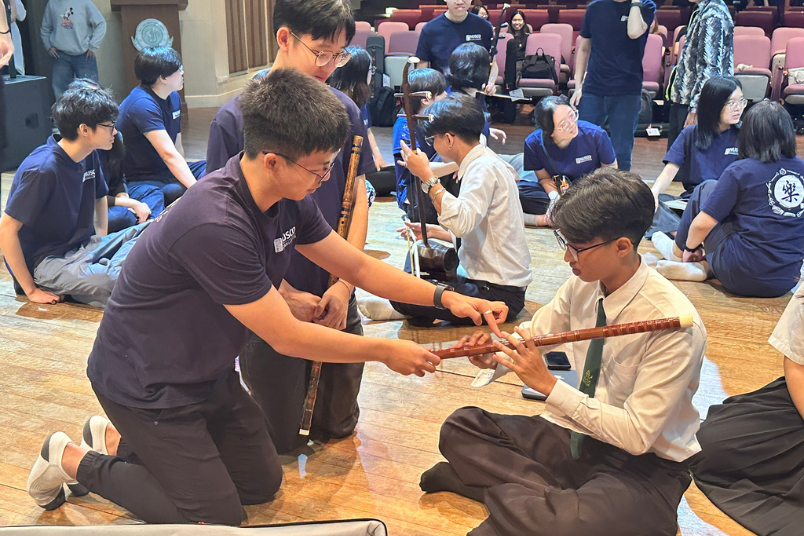
The following day, the programme continued at Kasetsart University (KU), where students joined a dance improvisation workshop and a traditional Thai-Chinese instrument exchange, paving the way for a joint performance by Kasetsart Winds and NUS two days later.
Putting up a joint showcase
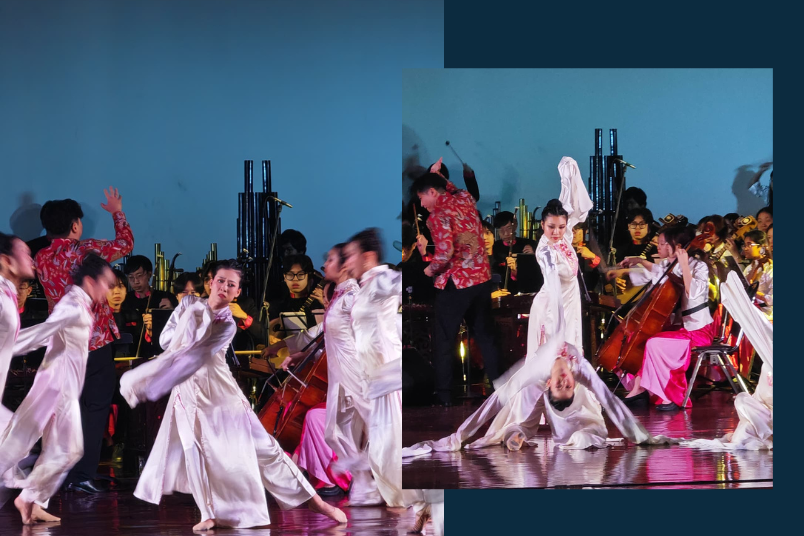
The exchange culminated in a joint performance at KU’s Prasert Na Nakhon Theatre on the final day of the trip. Conducted by A/P Jinnawat Mansap from KU’s Department of Music, the combined ensemble united NUSCO and KU Winds, alongside dance by NUSCD, in an abridged arrangement of the Butterfly Lovers Concerto. The work was specially arranged by Kasetsart Wind Symphony conductor Mr Surapol Thanyawibool, with NUSCO conductor Mr Moses Gay featured as concert soloist.
The innovative integration of Western wind instruments with Chinese orchestra and dance was a first of its kind. For most Thai audiences, it was their first experience of Chinese orchestra and dance, making the performance a compelling example of cross-cultural collaboration.
“The project adapted tradition by placing it in a collaborative setting, where Chinese music and dance were performed together and experienced by contemporary audiences. Rather than treating tradition as something to be kept unchanged, the project allowed it to function as a living practice,” said Ke Zhuoyan (Year 1, FOS), an erhu player with NUSCO.
Beyond its artistic achievement, the concert symbolised the possibilities of ASEAN partnerships, demonstrating how traditions with distinct tonal qualities and performance practices can complement one another to create new shared expressions.
Insightful student reflections
Students appreciated how this STEER programme broadened both their artistic and cultural perspectives. Many remarked that they were inspired to incorporate what they have seen and heard in their artmaking.
“I have learnt that tradition is not something static or outdated. It is something that can be negotiated and passed on through generations of people. The interplay of traditions and improvisation showed me that tradition can allow for careful adaptation while being respectful and innovative,” said Wang Yu Han (Y1, CDE), who plays zhongruan in NUSCO.
For Du Yiqing (Year 1, Business), the experience also deepened her understanding of the broader ecosystem that sustains the arts.
“Museums and universities play an important role in shaping how tradition is understood and transmitted. Universities connect this heritage to practice by encouraging structured learning, research and experimentation, allowing students to engage with tradition not only as something to preserve, but also to reinterpret and apply creatively,” she said.
Share:
Contributor
Office of Student Affairs